• Home
  • General Information
    • About Conference
    • Dates of Importance
    • Scientific Committee
    • Conference Speakers
    • Publication
  • Topics
  • Authors Guidelines
  • Paper Submission
  • Registration
  • Visa
  • Venue
  • History
  • Help & Support
  • Home
  • General Information
    • About Conference
    • Dates of Importance
    • Scientific Committee
    • Conference Speakers
    • Publication
  • Topics
  • Authors Guidelines
  • Paper Submission
  • Registration
  • Visa
  • Venue
  • History
  • Help & Support
  • Home
  • General Information
    • About Conference
    • Dates of Importance
    • Scientific Committee
    • Conference Speakers
    • Publication
  • Topics
  • Authors Guidelines
  • Paper Submission
  • Registration
  • Visa
  • Venue
  • History
  • Help & Support
Register Now
logotype

3rd International Academic Conference on Teaching and Education

  • Home
  • General Information
    • About Conference
    • Dates of Importance
    • Scientific Committee
    • Conference Speakers
    • Publication
  • Topics
  • Authors Guidelines
  • Paper Submission
  • Registration
  • Visa
  • Venue
  • History
  • Help & Support
AUTHOR: taraazamani98
HomeArticles Posted by taraazamani98
Featured-image.png
January 14, 2024
by taraazamani98Latest Newscopenhagen

Dining in Copenhagen

Noma

René Redzepi’s celebrated restaurant will forever be synonymous with Copenhagen’s culinary revolution – and years after its radical relaunch in a former ammunition depot near Christiania, the city’s infamous commune, it remains the hottest ticket in town. The dishes are as dazzling as ever, with Redzepi’s team rebooting the menu three times a year to showcase the season’s finest ingredients: game in autumn, seafood in winter and spring, and vegetables in summer.


Selma

The Michelin guide made culinary history when it awarded Selma a Bib Gourmand (for ‘exceptionally good food at moderate prices’). It was the first smørrebrød joint to receive the accolade – and the man responsible for taking the traditional Danish lunch to the next level was a Swedish chef. Nationalist feathers were ruffled, but open sandwich fans cheered: Selma puts a contemporary twist on the classic, using creative toppings such as elderflower herring with crème fraîche and buckwheat.


Alouette

This low-key fine-diner won a Michelin star in its first year – and it’s easy to see why. American chefs Nick Curtin and Andrew Valenzuela create seasonal dishes with global influences, like mackerel with fermented cucumber beurre blanc or charred pumpkin with caviar and mulberries. Located in an old factory in the post-industrial neighbourhood of Islands Brygge, Alouette is accessed via a graffiti-covered service elevator – a striking contrast to the restaurant’s glamorous décor and intimate vibe.


Harry’s Place     

For years, the humble hotdog was the go-to snack for peckish Danes. While you’ll still spot pølse vans around town, for a truly authentic experience, belly up to the bar at Harry’s Place. Founded in 1965 and located in a cabin in Nørrebro, it remains as popular as ever despite the culinary revolution that has swept Copenhagen. To feel like a local, order a Børge – a thick, juicy sausage – and wash it down with a bottle of chocolate milk.


Bistro Boheme

Take a break from touring the design stores of Bredgade for a meal at this neighborhood restaurant from chef Per Thostesen, favored by locals for its oysters and famous fried egg with pomme puree and truffles. Even if you’re not in the mood for a full meal, a draft beer and some fries at the bar make for a perfect pitstop


Barabba

Every day of the week, Barabba offers a murderers’ row of Italian dishes more concerned with pleasure than tradition. Consider three recent appearances on the menu: an appetizer of grilled octopus with spicy radicchio and Pantelleria capers; a primo of spaghetti with butter, colatura, and caviar; and an entree of hamachi that’s salt-crusted, grilled, and fried.


Balderdash

Geoffrey Canilao serves some of the city’s most creative cocktails at this basement bar located in the historic town center. A rotating series of themed menus highlights novel applications of ingredients like truffles and ice cream. Despite Balderdash’s spirit of invention, the dimly lit drinking hole is more welcoming dive than hushed performance space.



Kong Hans Kælder

Located in the underground cellar of the oldest building in Copenhagen, Kong Hans Kælder is the place to visit for grand European fine dining: turbot cooked in a salt crust, whole-roasted duck, and an impressive cheese cart. Bonjwing Lee has covered the restaurant and chef Mark Lundgaard Nielsen extensively on the Ulterior Epicure blog if you want to get a play-by-play of the magic.


TATA Cocktail Bar

Copenhagen is slowly becoming a great hotel city. The current star is the Sanders, around the corner from the ballet. The rooftop lounge is most tempting, but head to the acclaimed cocktail bar on the ground floor if you can’t do both. The servers couldn’t be kinder and the pressed ham and cheese sandwich approaches perfection.


Sanchez Cantina

The common refrain about chef Rosio Sanchez’s Vesterbro cantina is that it serves some of the best Mexican food anywhere, not just in Copenhagen. Good luck calling that hyperbole once you start working your way through the fleet of mezcals and Sanchez’s food. The breakfast taco is the sort of thing Angelenos would gladly wait hours to sample. Dinner is just as memorable, with tostadas of octopus al pastor and carnitas topped with grilled brigante cheese. Sanchez recently opened a second Cantina near Østerbro, and the two locations of her taco stand, Hija de Sanchez, should also be on your radar.


read more
Copenhagen-Hidden-Gems-Featured-Image.png
January 14, 2024
by taraazamani98Latest Newscopenhagen

Hidden Gems in Copenhagen

Cisterns

The Cisterns in Søndermarken, right next to the impressive Frederiksberg Gardens, is an underground museum featuring modern glass art from Denmark and around the world.


The Botanical Garden

The Botanical Garden is a green oasis in the middle of Copenhagen, right at Nørreport Station. Walk in the park and visit the beautiful exotic Palm House. Tip: If you’re want a bite to eat or something to drink head to the popular glass markets, Torvehallerne, which is a stone’s throw from the Botanical Garden and take a coffee break in one of Torvehallerne’s many stalls.
In the forests outside Copenhagen you will find six large wooden giants created by the artist Thomas Dambo. The giants are made of recycled wood and intended to get the city’s inhabitants to venture into nature and discover new places.


Bike on an old railroad

Amagerbanen was once one of the old railroads in Copenhagen. Today, only 1,5 km of the rails remains. But a group of enthusiasts has taken care of the passage, making it possible to ride trolleys through a magical tunnel of leafs.


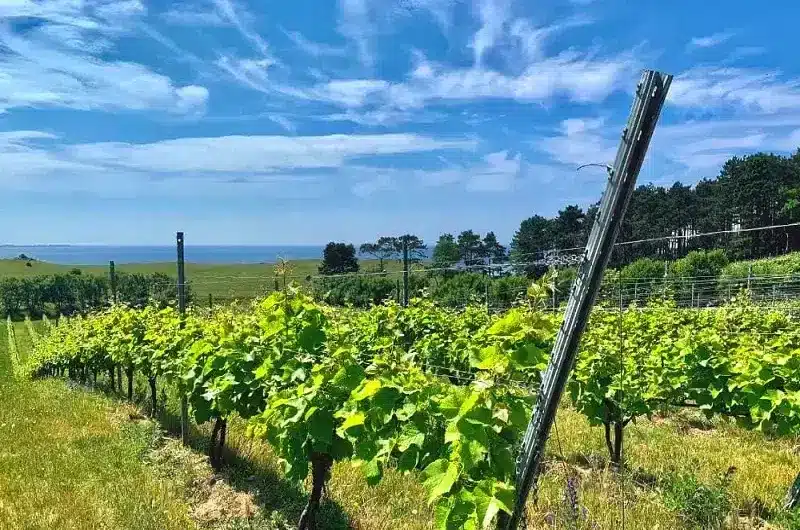
Rosnaes Wine Region       

You may not think of Copenhagen or Denmark when it comes to wine, but SURPRISE – Denmark has a wine region. This is due to advances in wine production and global warming, Denmark has a growing number of vineyards.
If you’re keen to visit a winery in Denmark, you can take the train to the Rosnaes peninsula, about 45 minutes outside of the city. It’s a beautiful destination with coastal charm and a microclimate that results in just enough sunny days to support an emerging wine industry.
Dyrehoj Vineyards is the largest wine producer in Denmark and they offer tours, tastings and year-round events. A perfect excuse to sample the best Danish wines on offer!


The Beaches of Copenhagen

Another travel attraction and Copenhagen gems that you wouldn’t associate with Copenhagen is a white sand beach, but they’re there and you should visit them.
Just south of the city centre, you can find the lovely Baltic Sea beachfront of Amager Strandpark. The park is a short walk from the M2 metro line and features 4.2 km of beach along a manmade island off the coast. It’s connected to the mainland by scenic bridges and off the coast, you can see the Middelgrunden wind farm.
While the waters aren’t as warm as Spain’s Costa Brava, the soft sand is wonderful on a sunny day and you can enjoy a swim in the offbeat Baltic waters.


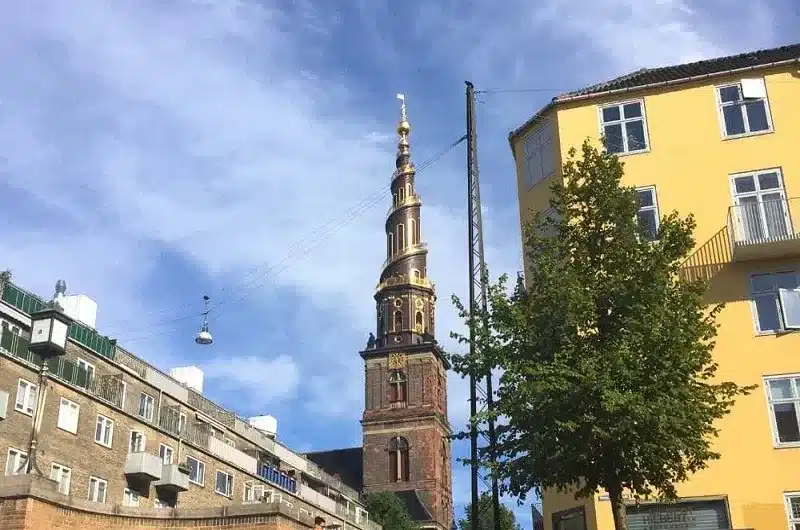
Climb the Spire of the Church of Our Saviour

Any time you visit a new city, getting a birdseye view from above is a good idea. In Copenhagen, the most popular place for tourists to take in a view is the historic Round Tower in the city centre. While it’s a lovely attraction, get a little offbeat and climb the unique Church of Our Saviour.
What makes the church unique is that you can climb to the very top of the structure because the spiral spire is actually an exterior staircase. If you don’t have a problem with heights, it’s the best way to see the city from above and a thrilling climb.
From the top, you have a wonderful view of the Christianhavn canals that you won’t see from the Round Tower. At the top, you can even see Sweden across the sound from the Danish coast.


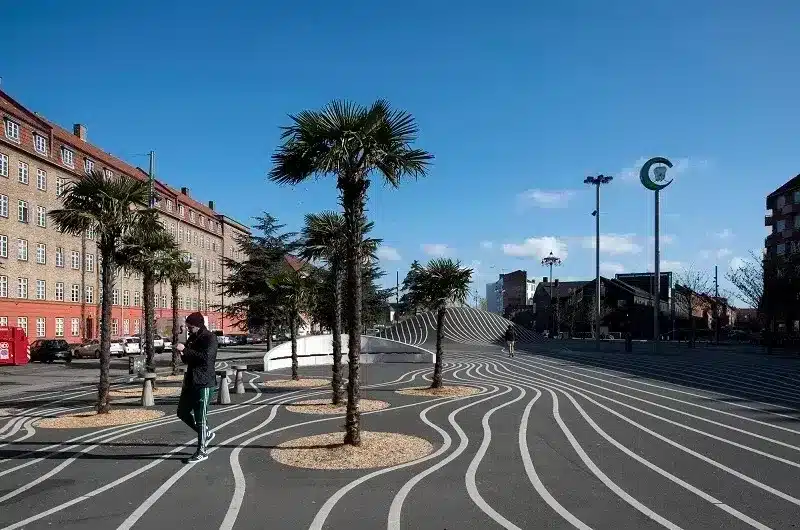
Superkilen

One of the best things about visiting Copenhagen is the abundance of green spaces and parks in the city. Among the most unique parks is Superkilen, located in the Norrebro neighbourhood. One of the best hidden gems in Copenhagen.
The area of the city is one of the most diverse and under-privileged sections of Copenhagen. Superkilen park was designed to be a place that brings together the local community with the refugee community in Copenhagen.
Elements of the park were designed with influences from countries around the world like a fountain from Morocco and sculpture from Japan. The park is beautiful in appearance, but the mission of tolerance makes it a truly special place to visit in Copenhagen.


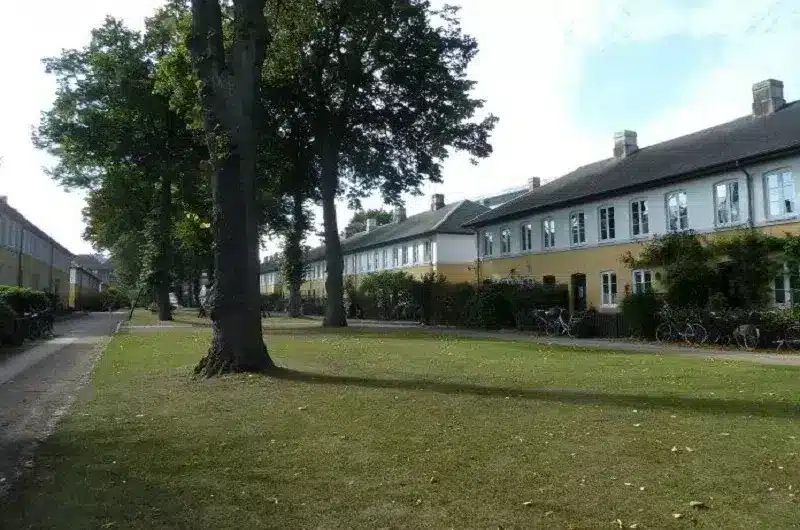
Kartoffelrækkerne

This spot is probably what most tourists would imagine Copenhagen to look and feel like. It was built back in the 19th century to accommodate the working class of Copenhagen. The cramped and charming two-story houses are among the best places to live in Copenhagen.
This spot was named Kartoffelrækkerne because it was built on old market gardens and its layout looked like rows of potatoes. The houses are located in the eastern parts of Copenhagen which are quiet and serene. They are also right next to the lakes. This makes Kartoffelrækkerne the ideal spot for strolling and jogging.


read more
Copenhagen-Attraction-Featured-image.png
January 14, 2024
by taraazamani98Latest Newscopenhagen

Copenhagens Attraction

Tivoli Gardens

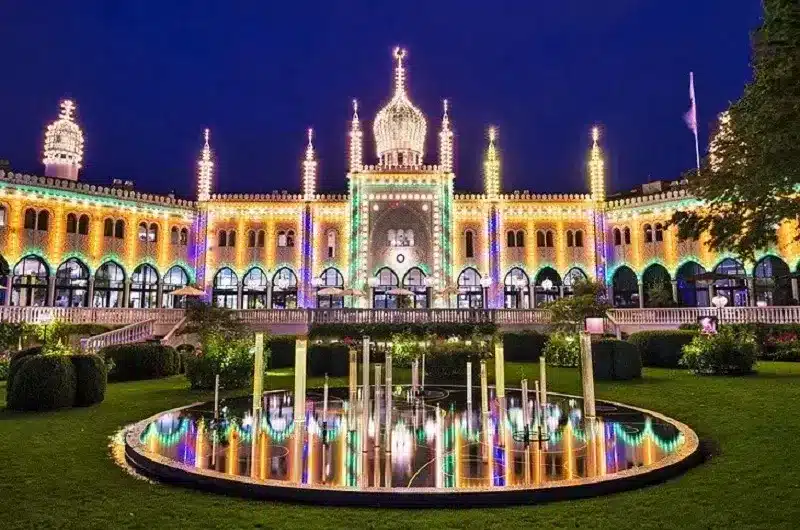
Walking from Town Hall Square and crossing H.C. Andersens Boulevard brings you to the inspiration behind the Disney theme parks: the famous Tivoli amusement park and pleasure gardens dating from 1843.
It’s impossible to miss the grand entrance at Vesterbrogade. Here, visitors are welcomed through a dramatic archway flanked by columns. No matter what time of year you visit, Tivoli feels festive.
Inside the gardens, you’ll wind your way through a village complete with cute shops and a lake adorned by well-lit trees that are mirrored serenely in the water. That’s likely the only serenity you’ll find in this miniature theme park, which brings out the kid in every visitor.
Here, you’ll also find more than 20 attractions, including a roller coaster; roundabouts; halls of mirrors; pantomime, puppet, and open-air theaters; a wealth of restaurants and cafés; flower gardens; and a Moorish-styled concert hall, which is particularly pleasing when lit up at night.
The park is famous worldwide and appears in many movies. Indeed, some might say it’s the most famous attraction in Copenhagen. At Christmas, Tivoli becomes an extravagantly decorated wonderland.
Address: Vesterbrogade 3, Copenhagen


Christiansborg Palace

On the tiny island of Slotsholmen is the Danish seat of government and an attraction that should top any visitor’s agenda. Christiansborg boasts more than 800 years of history and today, the palace is home to the Parliament, the Prime Minister’s Office, and the Supreme Court.
In addition, several parts are still used by the Royal House, although thankfully, much is open to the public. Occupying the site where Bishop Absalon built the earliest fortifications of the city in 1167, the ruins of the bishop’s castle and the medieval fortress were discovered when the present palace was under construction. They can now be seen by visitors.
Address: Christiansborg Slotsplads, Copenhagen


National Museum of Denmark

An easy 10-minute walk from Tivoli along Vestergade brings you to the National Museum (Nationalmuseet), a must-see attraction for anyone with an interest in Danish history and culture.
Some impressive runic stones are on display here, and the Danish history collection includes a sun chariot (cult object in the form of a cart) that is more than 2,000 years old, Romanesque and Gothic church fittings, Danish porcelain and silver, and collections of antiquities and coins.
The ethnographical collection, including items from Greenland, gives an excellent impression of life among the Eskimos. Inside, you’ll also find collections from other interesting areas including, Asia, Africa and Oceania, as well as the culture of the Indians.
That’s not all! Here, you’ll also find the Prince’s Palace (1744), a Rococo building influenced by the French style of the period. Around five-minutes’ stroll from the National Museum, Thorvaldsen’s Museum is also worth a visit to view spectacular works from this famous Danish sculptor.
Address: Ny Vestergade 10, Copenhagen


Nyhavn Harbor        

To the rear of Amalienborg lies Nyhavn (New Harbor), which is flanked by a street of the same name. This enchanting area is a hub of activity, especially during summer. Brightly painted gabled buildings line the canal, adding a splash of color to dreary days and enticing visitors to stop in for a peek at the wares for sale in the shops and a tasty bite in the restaurants and cafés that call this place home.
At the end of the harbor, an anchor serves as a memorial to Danish sailors who lost their lives in World War II. Nyhavn was once a disreputable quarter of the city, but now, with its majestic feel, it is a particularly charming part of Copenhagen that features in countless images of the city.


Den Bla Planet

Although you won’t likely notice this from the ground, Den Bla Planet (a.k.a. the National Aquarium Denmark) was built to resemble a whirlpool. Think that’s cool? Head inside where the aquarium’s wow factor is even more impressive!
The largest aquarium in Northern Europe, Den Bla Planet is one of the best attractions in Copenhagen. The building’s aluminum-covered walls evoke rolling ocean waves while the aquarium’s inner pathways flow like tributaries from the central core through eight sections.
These paths are lined by close to 50 aquariums and installations that house everything from eagle rays to turtles to hammerhead sharks to seahorses to moray eels to alligators. There is no shortage of creatures to see here.
Whether you’re hoping to spot ocean animals up close or are interested in the marine life that call tropical rivers and lakes home, you’re sure to find something inspiring in this venue. Watch the otters play, touch a creature in the tropical touch pool, or visit the café for a treat.
Address: 2770 Kastrup, Copenhagen


The Round Tower (Rundetårn)

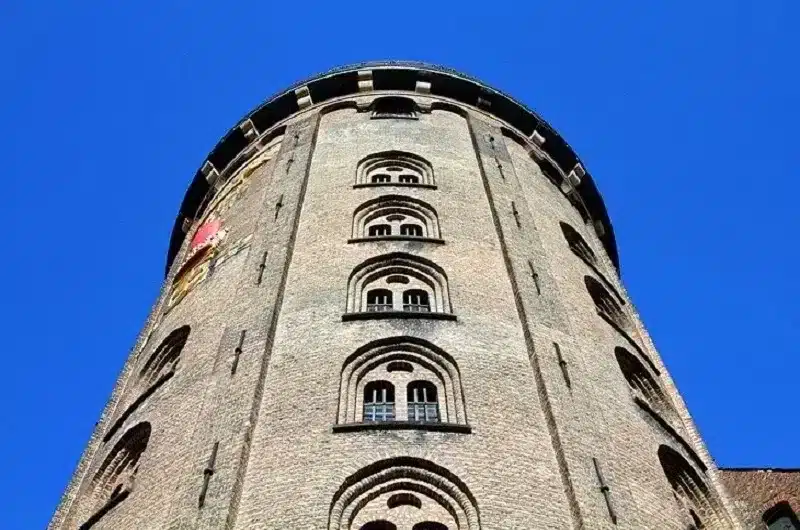
On Købmagergade is the Round Tower (Rundetårn), a 36-meter-high structure built as an observatory in 1642. It now also houses a small collection connected with the famous Danish astronomer Tycho Brahe.
A particular treat is the platform, reached by a wide spiral ramp. From the top are magnificent panoramic views over the city. A new attraction is the glass floor hovering 25 meters above the ground where you can peer down into the castle’s core.
Fans of Hans Christian Andersen will be interested to know that the tower features in his well-known story The Tinderbox – “eyes as big as the Round Tower.”
After taking in the views and getting your breath back, why not continue on with a short walk around the Old Town? Wander by way of Skindergade and Kejsergade to Gråbrødretorv, one of Copenhagen’s most charming squares with its brightly colored old houses.
Address: Købmagergade 52A, Copenhagen


Amalienborg Castle

Less than one and a half kilometers from Rosenborg in the Frederiksstaden quarter, you’ll find Rosenborg’s sister palace, Amalienborg, along with its serene waterfront gardens.
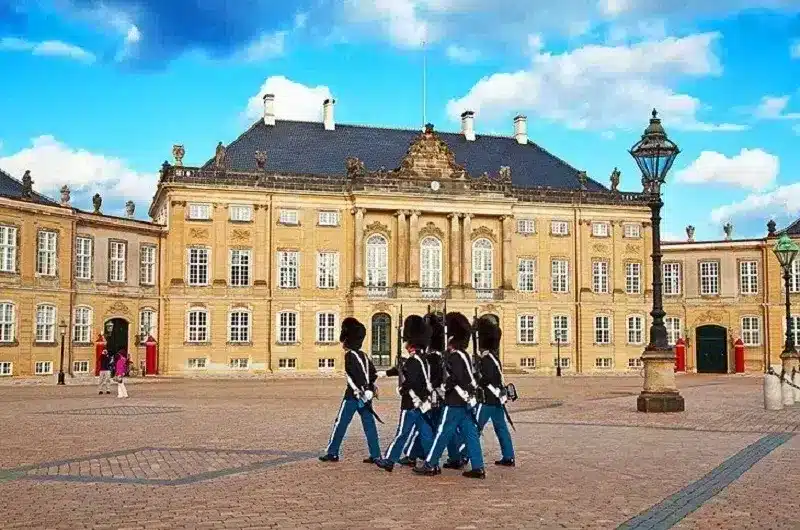
The four palaces facing onto the square were originally built as homes for the nobility, but were taken over by the Royal Family after a fire at Christiansborg in 1794. The palace takes its name from Queen Sophie Amalie who had a sumptuous summer retreat on the site, which also burned down in 1689.
The area was designed to be a model society with the King as focal point and the aristocracy (the four palaces) surrounding him. Today, Queen Margrethe II and her family occupy the upper story of Christian IX Palace, and the Moltke Palace is used for official purposes. The soldiers of the Royal Guard with their bearskins and blue (on festive occasions red, white, and blue) uniforms are a unique symbol of the city.
Address: Amalienborg Slotsplads, Copenhagen


Strøget Shopping Mile

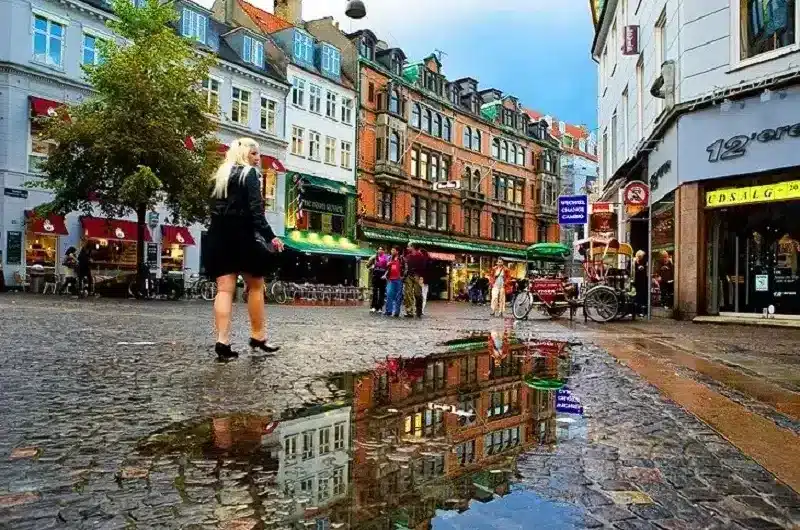
A stroll of around five minutes from Christiansborg takes you to the bustling shopping area of Strøget where you’ll find a wealth of boutiques, cafés, and restaurants.
Strøget, a nickname from the 1800s, consists of several roads crisscrossing one another, beginning at Town Hall Square (Rådhuspladsen) and ending at Kongens Nytorv. Some adjoining streets on the north have also been pedestrianized.
International brand-name stores such as Max Mara, Prada, Louis Vuitton, and Hermès tend to be at the end of the street facing the direction of Kongens Nytorv. Follow Strøget towards City Hall Square for more affordable shopping at H&M, Weekday, and Zara.


Rosenborg Palace

Less than 10-minutes’ walk from the Round Tower and now home to some of Denmark’s greatest cultural treasures, this castle was originally built by Christian IV as a pleasure palace.
Inhabited by the royal family until 1720 and after that used as a summer retreat, the castle and contents became a museum in 1838. In the basement are the Danish crown jewels and royal regalia.
Of particular interest are the Marble Room, a Baroque reception room, and the Knights’ Hall with the Coronation Throne (used between 1871 to 1940), as well as the famous Rosenborg Tapestries, which have adorned the walls since 1693. Exquisite porcelain is also on exhibit, including the famous Flora Danica service.
Address: Øster Voldgade 4A, Copenhagen


Town Hall Square

Busy Town Hall Square (Rådhuspladsen) is dominated by Copenhagen Town Hall (built between 1892 and 1905), which is based on a mix of Italian Renaissance and medieval Danish architecture.
For marvelous views, you can climb the tower; at 106 meters high, it is the tallest in the city. The building itself is richly adorned with sculptures and paintings.
Above the main entrance is a figure of Bishop Absalon in gilded copper, and in the Great Hall are busts of Danish notables such as Martin Nyrop (1849-1921), the architect who designed the building, the sculptor Bertel Thorvaldsen (1770-1840), Hans Christian Andersen (1805-76), and the physicist Niels Bohr (1885-1962).
The World Clock at the main entrance was designed and constructed by Jens Olsen in 1955 and shows not only the time and date, but also various astronomical constellations.
Address: Rådhuspladsen 1, Copenhagen


read more

ICTEDUCATION Conference

Email: info@icteducation.org

Phone: +370 645 17 211
Facebook-f

Useful Links

Topics
committee
Speakers
Publication
Presentation Types
City Tour
News
Organizer
Help & Support
Privacy Policy

Subscribe to our newsletter

  • This field is for validation purposes and should be left unchanged.

Copyright © 2026 ICTEDUCATION. All Rights Reserved